The first page of Google for “construction leadership” is full of advice from people who never built one. Vision, adaptability, communication, the same ten traits in fifteen different orders. None of it tells you what to do when a foreman who has been on the crew for eight years stops showing up on time, or how to keep a $15M company alive when the phones go quiet for a year, or what to say to a steel crew the morning after one of them lost a brother to suicide.
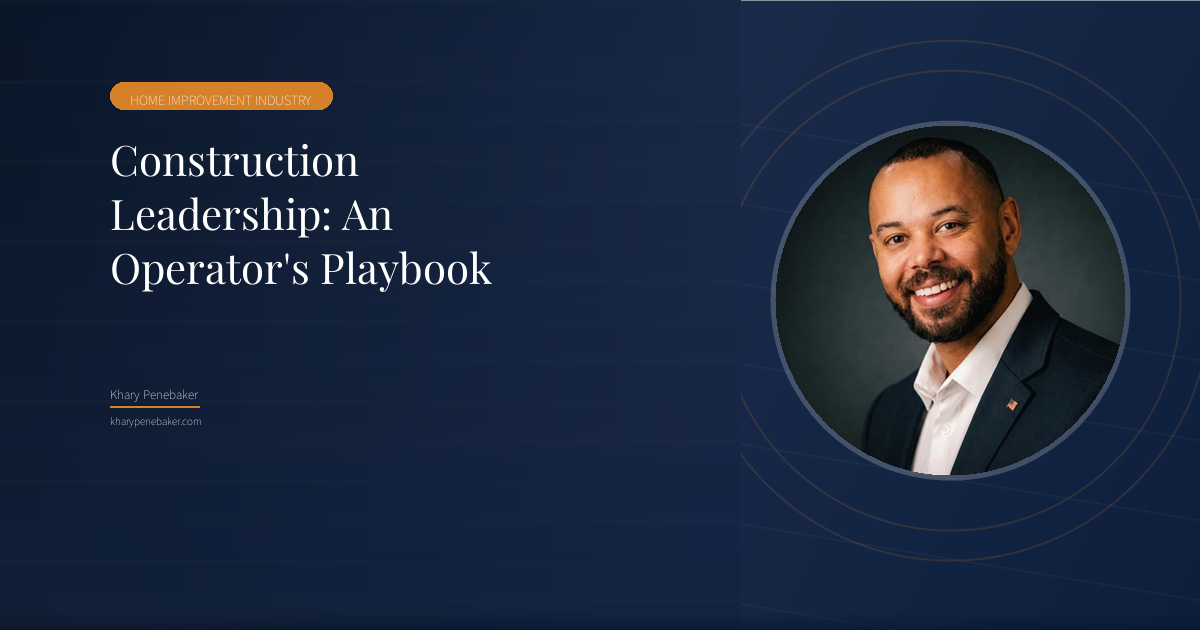
This page is the answer I wish I had when I was 25 and had just started Penebaker Enterprises with a truck, a crew of two, and a $1.5M revenue line. Over the next decade I grew that company to $15M and 50 people. Later I helped scale Roofed Right America to $35M+ and 180 people. I have OSHA 30 twice. I have run jobs in EPDM, TPO, and sheet metal across three states. I have hired great people and let go of people I cared about.
Construction leadership is not a list of traits. It is a series of decisions you make under pressure, with imperfect information, where the wrong call costs somebody their margin, their job, or their life.
Here is what I know.
TL;DR: Construction leadership is the daily practice of making safety, scope, schedule, money, and people decisions under pressure. The best construction leaders are calm, decisive operators who can talk to a foreman in the field and a CFO in the boardroom, run a job and a P&L, and address mental health on the jobsite the same way they address fall protection.
What construction leadership actually is, and what it isn’t
Construction leadership gets defined in two wrong ways online.
The first wrong definition is the consultant version. A list of soft traits, “vision” and “adaptability” and “emotional intelligence,” dressed up with stock photos of people in hardhats pointing at clipboards. That definition is worthless on a Tuesday afternoon when your project manager just told you the structural steel is two weeks late and the GC is threatening liquidated damages.
The second wrong definition is the field version. Leadership as toughness. Loudest voice, longest hours, biggest scars. That gets you respect for about six months, then it gets you a team that hates you, a turnover rate that kills your margin, and a reputation among the good crews that costs you bids you never even know about.
Real construction leadership is operational. It is the daily practice of making the right call on safety, scope, schedule, money, and people, with the information you have, in the time you have. It is being calm enough that the foreman tells you the truth, technical enough that the engineer respects you, and credible enough that the bonding agent renews your line.
The rest of this page is the operator version. No frameworks I read in an MBA class. Just what I did, what worked, what broke, and what I would tell my 25-year-old self if I could.
The five jobs of a construction leader
Strip out the abstraction and a construction leader has five jobs. Every decision sorts into one of them. If you can name which job a meeting is actually about, you stop having useless meetings.
- Safety. The crew goes home with all their fingers. This is non-negotiable, and it is also a margin issue. Falls cause 38% of construction fatalities according to BLS data, and every recordable injury raises your EMR, which raises your insurance, which kills your bid competitiveness.
- Scope. What you sold is what you build. Scope creep on a fixed-price job is how good companies go broke. Scope discipline is the unsexy heart of profitability.
- Schedule. Time is money in this industry literally. A job that runs four weeks long on a 16-week schedule loses 25% of its margin to overhead drag. Schedule is a financial document.
- Money. Cash flow, gross margin per job, billings vs. costs, retainage. If you cannot read a job-level P&L by lunch on Friday, you are not running the company. The company is running you.
- People. Hiring, training, promoting, and yes, firing. The single biggest determinant of which construction companies survive a decade is whether the leader knows how to attract and keep good people.
Most construction leaders who fail get four of these right and one of them spectacularly wrong. The one they get wrong is usually money, because nobody taught them how to read a P&L, or people, because they confuse intimidation with leadership.
Leading on safety without making it theater
The construction industry killed 1,032 workers in the most recent BLS Census of Fatal Occupational Injuries. The fatality rate of 9.2 deaths per 100,000 full-time equivalent workers is roughly three times the all-industry average. Falls are the number one killer, accounting for 389 of those deaths.
Most construction companies respond to those numbers with safety theater. Posters in the breakroom. A morning toolbox talk that the foreman reads in monotone. An annual training session with a video from 1998. A safety officer whose actual job is paperwork.
That kind of safety program does not save lives. It documents your liability for after one ends.
Real safety leadership is operational. What actually moves the needle:
Make safety a foreman conversation, not an HR conversation. The crew listens to the foreman. The crew tunes out HR. If your safety culture is being delivered top-down through a corporate program instead of crew-up through the foremen who run the jobs, you have a paperwork program, not a safety program.
Audit the gap between what you wrote and what is happening on the deck. I used to walk roofs unannounced. Not to catch people. To see what the actual practice was. Tie-off compliance on a 30-foot deck looks great on the JHA and terrible at 2:00 PM in August when the harness is hot and the crew is behind schedule. Your job as a leader is to know the gap and close it.
Mean it when you stop a job. A safety culture is built or destroyed the moment a leader either does or does not stop production over an unsafe condition. Stop a $40K-a-day job to fix a railing because it is the right call, and every crew on every site you ever run knows what you stand for. Don’t stop it, and they know that too.
OSHA gives you the rules. Your job as a leader is to make the rules real on the deck.
How to scale a construction company without losing the field
Penebaker Enterprises went from $1.5M to $15M in roughly eight years. Roofed Right America scaled to $35M+ and 180 people. The honest answer for what makes scaling work in construction is this: most things that worked at $1.5M will break you at $10M, and most things that work at $10M will break you at $30M. You have to rebuild the company at every revenue tier.
Three breaking points worth naming.
$3M to $5M, stop being the bottleneck. Below $3M, the founder runs everything. Above $5M, the founder cannot. The transition is brutal. You hire a project manager, you delegate estimating, you stop touching every change order. Most construction companies stall at this tier because the founder cannot let go of jobs they used to win personally. The fix is systems: standardized bid packages, a CRM (even a spreadsheet works), and weekly job-level financial reviews with project managers who own their numbers.
$8M to $12M, build a real second tier of leadership. This is where companies either professionalize or stay craft shops. You need an estimator who is not you, a controller, a field operations manager, and the discipline to let those people make calls without checking with you. The temptation is to keep being chief decider on every issue. That is exactly what kills you, because you become the constraint. The math is simple. There are only so many decisions a single human can make in a day, and a $10M business has more decisions than that.
$20M to $40M, become a real company. At this tier you are not running jobs anymore. You are running the company that runs the jobs. Whatever operating system you adopt, the goal is the same: clear roles, predictable rhythms, KPIs that people own. I have seen construction companies bounce off this tier for years because the founder cannot stop being the foreman of the foremen.
The thread through all of it: scaling in construction requires letting go of the work that built the company so you can build the company that does the work. More on this in scaling a $15M construction company and building a $35M operation.
Hiring, firing, and the foreman conversation nobody wants
The hardest leadership work in construction is the people work. It is also the work most owners avoid until it has cost them everything.
On hiring. The single biggest hiring mistake construction leaders make is hiring for skill alone. Skill is the floor, not the ceiling. I will take a B-skill carpenter with A-character over an A-skill carpenter with B-character every single time, because the first one is on time, calls when there is a problem, treats his apprentices well, and stays five years. The second one is gone in 14 months and leaves a culture problem behind.
The trades shortage is real. ABC’s most recent industry analysis says construction needs to attract 349,000 workers in 2026 just to meet demand. But the trades shortage is also a leadership problem, not just a labor-market problem. Companies that train, treat people well, and create real career paths do not have a shortage. They have a waiting list. More on this in the trades shortage is a leadership problem.
On firing. The conversation no construction leader wants to have is the one with the long-tenured employee who has stopped performing. Eight years on the crew, knows everybody’s families, was at your wedding. The performance has been slipping for a year. You keep telling yourself it is a phase.
It is not a phase. The longer you let it run, the more it costs you, because the rest of the crew is watching. They know who is and who isn’t pulling their weight. The day they conclude that you will not deal with it is the day your A-players start looking for other jobs.
The framework I use:
- Talk to them honestly. Name the gap. Be specific. Listen.
- Give them a real shot at correction. Clear measures, clear timeline, real support.
- If it does not move, end it cleanly. Direct, respectful, with whatever severance you can afford.
Drift is the enemy. Letting a performance problem fester for two years out of misplaced loyalty is not loyalty. It is cowardice dressed up as kindness. See how to fire someone and still sleep at night for the longer version.
Mental health on the jobsite is a leadership problem
This is the section the consultant pages will not write.
The CDC’s surveillance data on suicide by industry, published in MMWR in 2023 from 2021 NVDRS data, found that male construction workers die by suicide at a rate of roughly 56.0 per 100,000. That is roughly four times the rate for all working-age men. Construction workers represent only 6% of US employment but account for 17.9% of male suicides where industry is reported.
Construction has the highest suicide rate of any industry, and construction leaders have spent decades pretending otherwise.
I am not a clinical psychologist. I am a construction industry operator whose mother died by suicide when I was 22 months old. I have lived on both sides of that statistic, the side where you build the companies and the side where you bury the people. So when I tell you this is a leadership problem, it is not from a textbook.
So what do you actually do as a leader.
Talk about it. The single biggest barrier to suicide prevention in construction is silence. The macho culture that says “tough it out” is killing people. A leader who names mental health out loud, in a toolbox talk, in a company meeting, gives the crew permission to be human.
Train your supervisors to recognize signs. Withdrawal, increasing absences, giving away possessions, talking about being a burden. These are not soft skills. They are operational early warnings, the same way you would train a foreman to spot a structural anomaly.
Make the resources real. OSHA’s own guidance is direct: post the 988 Suicide and Crisis Lifeline number on every site, include EAP information in onboarding, train a small group of supervisors to be the first call. OSHA’s Preventing Suicides in Construction page is the operational playbook.
Never punish someone for asking for help. If your culture penalizes a worker for taking a mental health day, you will lose people to suicide that you could have saved. It is that simple.
For families and people in crisis, what every family needs to know about firearm suicide prevention is the deeper read. The 988 line is available 24/7, free, confidential.
Leading through a downturn (what 2008-2011 taught me)
I ran Penebaker Enterprises through the worst construction recession since the Great Depression. Commercial roofing volume in the upper Midwest dropped roughly 40% in 18 months. Bonding agents tightened. Receivables stretched. A handful of regional general contractors we had worked with for years went out of business and took their unpaid invoices with them.
Here is what I learned about leading construction through a downturn.
Cut from the top first. I cut my own salary in half before I cut a single field paycheck. The crew sees who you protect. If you protect the suits before you protect the steel, the field will never trust you again.
Be honest about cash. I had a Friday morning all-hands every week of 2009 where I told the company exactly where we were on receivables and pipeline. People can handle bad news. They cannot handle being lied to.
Protect your A-players above all else. In a downturn, the ten best people in your company are the difference between coming out alive and not. Pay them. Give them stretch work. Make them feel like the company is theirs. They will carry the rest of you through.
Don’t stop bidding. Most companies pull back on estimating during a downturn. That is exactly when the better-run firms grow share. Your bidding cost is fixed. Your conversion is what changes. We came out of 2011 with a bigger book of business than we had going in because we never slowed down.
Have the cash conversation with your customers. Most general contractors in 2009 were also struggling. The companies that survived were the ones that talked openly about payment terms, change orders, and pipeline. Vendors who hid from those conversations died.
A downturn is a leadership accelerant. It compresses two years of decisions into two months. The construction leaders who come out the other side stronger are the ones who lead with calm, transparency, and discipline. The ones who panic, hide, or cut indiscriminately rarely come back. Resilient leadership is the longer read on this.
How to tell if your construction leadership is working
Construction leaders track too many metrics and the wrong ones. Five numbers actually tell you whether your leadership is working.
- Voluntary turnover. Industry average is roughly 21% in construction. If you are above that, your leadership has a problem. Below 12% is excellent. Above 30% is a fire.
- OSHA recordable incident rate. If you are above the BLS construction average, your safety leadership is broken. If you are at or below, you are doing the work.
- Gross margin trend by quarter. Not absolute margin, the trend. Trending up means your scope discipline and your job costing are working. Trending down means you are selling jobs you cannot execute, or executing jobs you did not bid right.
- Repeat-client revenue percentage. What percentage of this year’s revenue came from clients you served last year? Above 60% means your delivery is working. Below 40% means you are running a sales engine, not a construction company.
- Internal promotion rate. How many of your current managers were field workers in your company three years ago? If the answer is zero, you have a culture problem. If the answer is most of them, you are building the next generation of construction leaders, which is the only sustainable competitive moat in this industry.
If those five numbers are moving the right direction, you can ignore most of the noise. If they are not, no amount of leadership theory will save you. What the home improvement industry gets wrong about leadership is the related read for owners who want to benchmark.
The whole story is on the My story page.
Common questions
What does good construction leadership actually look like on a jobsite?
Direct, calm, decisive. A construction leader knows the work, talks to the crew without ceremony, and makes calls before they become fires. Operational decisions on safety, scope, schedule, money, and people are made fast and made well.
What are the most important leadership skills in construction?
Safety judgment, scope discipline, financial literacy, hiring instinct, and the willingness to have hard conversations. The technical skills are the floor. The people skills are the ceiling. Construction leaders who lack any one of these tend to fail spectacularly.
How do you lead a construction team through a downturn?
Cut from the top first. Protect the field. Be honest about cash. Keep your A-players close and your customers closer. Do not stop bidding when everyone else does. Companies that lead through a downturn with calm and transparency come out stronger.
Why is the construction industry so short on leaders?
Roughly 41% of current construction executives are eligible to retire by 2031, and the trades pipeline has lagged for two decades. The shortage is a leadership problem before it is a labor problem. Companies that train, treat people well, and create real career paths do not have a shortage. They have a waiting list.
What do you do when a long-tenured employee is no longer performing?
Talk to them honestly and name the gap. Give them a real shot at correction with clear measures and a clear timeline. If it does not move, end it cleanly with respect and severance. Drift kills the rest of the crew faster than the original problem.
How does a construction leader address mental health on the jobsite?
Take the suicide rate seriously. Construction has the highest suicide rate of any industry. Train supervisors to recognize signs, post the 988 Suicide and Crisis Lifeline on every site, include EAP information in onboarding, and never punish someone for asking for help.
What metrics tell you whether your construction leadership is working?
Voluntary turnover, OSHA recordable rate, gross margin trend by quarter, repeat-client revenue percentage, and how many people you have promoted internally in the last 24 months. If those five numbers are trending the right direction, your leadership is working. If not, no theory will save you.
Last updated: September 25, 2026